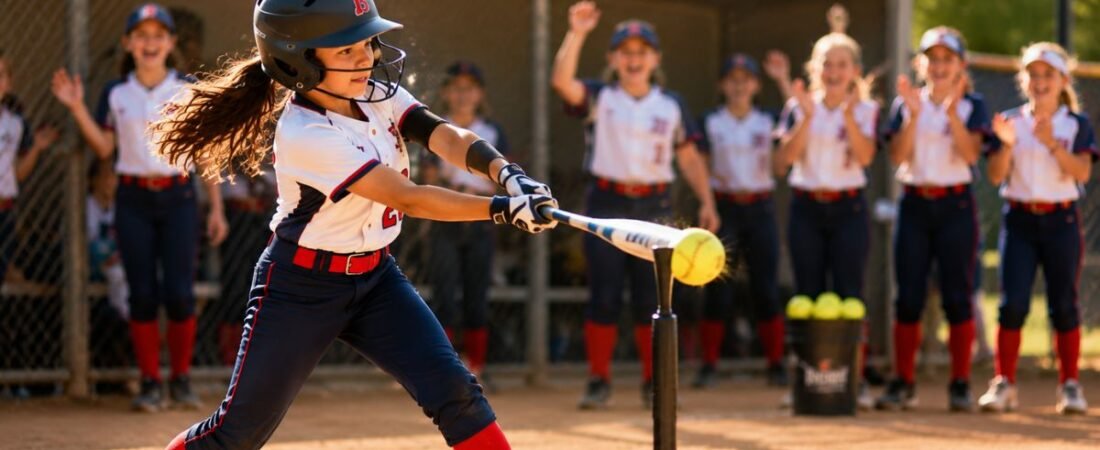
Softball practice doesn’t have to feel like a chore. If players are dragging their feet through the same repetitive drills, it’s time to mix things up with games that build real skills while keeping the energy high.
Below are 18 fun games for softball practice, organized by hitting, fielding and throwing, base running, pitching, and team building. Every game includes the equipment you need, how long it takes to set up, step-by-step rules, and coaching points — so you can run it at your next practice without any guesswork.
These games work for 8U through high school; age-specific tips are included where it matters.
Why Game-Based Practice Works
Traditional drills repeat the same motion over and over. Game-based practice puts players in live, competitive situations that mirror what actually happens in a game. Coaches use this approach because it:
- Keeps players moving instead of standing in long lines
- Builds decision-making and situational awareness, not just mechanics
- Makes practice something players look forward to
- Naturally develops hustle, competitiveness, and communication
Quick-Reference Table
| # | Game | Skill Focus | Best For | Setup Time |
|---|---|---|---|---|
| 1 | Knockout Batting | Hitting | All ages | 2 min |
| 2 | Home Run Derby | Power hitting | All ages | 3 min |
| 3 | Bunt Battle | Bunt control | 8U–12U | 3 min |
| 4 | Slap Hitting Challenge | Speed/contact | 10U+ | 2 min |
| 5 | Infield Knockout | Fielding under pressure | 10U+ | 1 min |
| 6 | Around the Horn Relay | Throwing/teamwork | 12U+ | 2 min |
| 7 | Rapid Fire Ground Balls | Reaction/footwork | All ages | 1 min |
| 8 | Target Throw Challenge | Throwing accuracy | 8U–12U | 2 min |
| 9 | Pickle (Rundown) | Base running/tagging | All ages | 1 min |
| 10 | 3-2-1 Run Contest | Speed | All ages | 1 min |
| 11 | Base Relay Races | Base running/teamwork | All ages | 2 min |
| 12 | Steal the Bacon | Reaction speed | 8U–10U | 1 min |
| 13 | Strike Zone Target Game | Pitch control | Pitchers, 10U+ | 3 min |
| 14 | 21 Pitching Challenge | Pitching under pressure | 12U+ pitchers | 1 min |
| 15 | Workup | Full-game situational play | 10U+ | 2 min |
| 16 | Round-Robin Mini Tournament | Full scrimmage | High school/travel | 5 min |
| 17 | Freeze Tag Softball | Agility/base running | 8U beginners | None |
| 18 | Situational Scrimmage | Game IQ/decision-making | 12U+ | 2 min |
Hitting Games
1. Knockout Batting
Equipment: Tee or soft-toss net, bat, 10+ balls How to Play: Set up two batting stations. Players compete in pairs to see who can hit a line drive or ball past the infield first. The loser rotates out; the winner stays to face the next challenger. Coaching Points: Reward solid contact, not just hard swings a clean line drive should score higher than a mishit ground ball. Variation: For younger players, use a tee; for advanced hitters, use soft toss or live pitching.
2. Home Run Derby (Point-Based)
Equipment: Tee or soft toss, 15+ balls, cones to mark zones How to Play: Mark distance zones in the outfield with cones. Each batter gets 6–8 swings. Ground balls = 1 point, line drives through the infield = 3 points, deep outfield drives = 5 points. Highest score wins. Coaching Points: Emphasize a level swing and using the lower body for power, not just the arms. Variation: For 8U–10U, move zones closer and reward contact over distance.
3. Bunt Battle
Equipment: Bat, 10+ balls, cones or chalk to mark zones How to Play: Players get three attempts to bunt the ball into marked zones down the first- and third-base lines. Award points based on placement — closer to the foul line scores higher. Coaching Points: Keep the bat angled and use soft hands to absorb the ball rather than poking at it. Variation: For a team version, split into two groups and total the scores.
4. Slap Hitting Challenge
Equipment: Tee or soft toss, stopwatch How to Play: Set up a slap-hitting station. After contact, players sprint down the line to first base. Time them and post results on a leaderboard. Coaching Points: Focus on quick, short swings and getting out of the box fast rather than full power. Variation: Best suited for faster players and 12U and up.
Fielding and Throwing Games
5. Infield Knockout
Equipment: Bat, 15+ balls, full infield How to Play: Line players up at a position (shortstop works well). Hit ground balls to each player in rotation. Any player who boots the ball or makes an inaccurate throw is “out” for that round. Last player standing wins. Coaching Points: Stay low, field the ball out in front, and make a quick, balanced throw. Variation: Mix in slow rollers, hard grounders, and short hops to challenge different skills.
6. Around the Horn Relay
Equipment: Softballs, full infield How to Play: Split the team into two groups and race to complete a full around-the-horn throw (third to second to first to home, or a similar order) without an error. First team to finish cleanly wins the round. Coaching Points: Emphasize quick glove-to-hand transfers and clear, chest-high throws. Variation: Time each round and challenge the team to beat its own record.
7. Rapid Fire Ground Balls
Equipment: Bat, 15+ balls How to Play: Set a 60-second timer. Roll or hit ground balls to a player as fast as they can be fielded cleanly and thrown to a target. Count clean reps and compare scores across the team. Coaching Points: Prioritize clean fielding over speed — a dropped ball doesn’t count. Variation: A favorite for 10U and 12U practice because it’s simple, fast-paced, and easy to explain.
8. Target Throw Challenge
Equipment: Bucket or cones as targets, 10+ balls How to Play: Place targets at different distances. Give each player several throws and award points for hitting a target closer targets are worth fewer points, farther targets more. Coaching Points: Step toward the target before releasing the ball; this alone improves accuracy significantly. Variation: Move targets farther away as players improve.
Base Running Games
9. Pickle (Rundown Challenge)
Equipment: Two bases, softballs How to Play: Place two bases 30–40 feet apart. Position a fielder at each base with one or two runners in the middle. Fielders throw the ball back and forth while the runner tries to reach a base safely. A tagged runner swaps places with the fielder who tagged them. Coaching Points: Throw to the runner’s front foot and communicate clearly to avoid double-covering a base. Variation: Add a second runner for a more chaotic, game-like version with older players.
10. 3-2-1 Run Contest
Equipment: Stopwatch, bases How to Play: Time players running from home to first, first to third, or a full trip around the bases. Post times and let players try to beat their personal best each week. Coaching Points: Teach proper base-rounding technique (wide turns, touching the inside corner of the bag) before turning it into a race. Variation: Track times over a season to show measurable improvement.
11. Base Relay Races
Equipment: Softball (used as a baton), four bases How to Play: Split the team into two groups one starting at home, one at second base. On the signal, the first runner from each group sprints around the bases carrying the ball, then hands it off to the next teammate. First team to have everyone finish wins. Coaching Points: Watch for proper base-running form even under race conditions. Variation: Great as a warm-up or a cool-down activity to close practice.
12. Steal the Bacon
Equipment: One softball How to Play: Line up two teams facing each other and assign each player a number. Place a ball between them. Call a number — those two players race to grab the ball and return safely to their own line without being tagged. Coaching Points: Emphasize a quick first step and staying low when picking up the ball. Variation: Best for 8U–10U players; use a soft/foam ball for safety.
Pitching Games
13. Strike Zone Target Game
Equipment: Strike-zone mat or taped zone, catcher’s gear, 15+ balls How to Play: Mark specific zones within the strike zone (inside-high, outside-low, etc.). The pitcher calls or is assigned a zone and throws a set number of pitches, earning points for hitting the called location. Coaching Points: Focus on a consistent release point rather than trying to throw harder for accuracy. Variation: For 10U, use a larger target zone; for older pitchers, add movement pitches.
14. 21 Pitching Challenge
Equipment: Catcher’s gear, strike-zone target, 15+ balls How to Play: Pitchers start at zero points. A called strike is worth 2 points, hitting a specific target spot is worth 3, and a pitch outside the zone costs 1 point. The goal is to land on exactly 21 points without going over like blackjack. Coaching Points: This works best after pitchers already have solid mechanics; the pressure element tests composure, not form. Variation: Best suited to 12U and up pitchers who are already comfortable throwing strikes consistently.
Team and End-of-Practice Games
15. Workup
Equipment: Full field, full equipment How to Play: Designate a few hitters; everyone else takes the field. When a batter is out, they go to the back of the fielding rotation and every fielder moves up one position toward hitting. It plays out like a live scrimmage. Coaching Points: This is one of the best games for building situational awareness because it mimics a real game closely. Variation: Works well as a season-long favorite — most teams request it regularly.
16. Round-Robin Mini Tournament
Equipment: Full field, full equipment How to Play: Divide the team into three or four small squads and run a quick round-robin using simplified rules — fewer innings, modified bases. This gives players a game experience without the pressure of an official matchup. Coaching Points: Good for late-season practices when players need competitive reps without a full scrimmage. Variation: Best for high school or travel-level teams with enough players to split into groups.
17. Freeze Tag Softball
Equipment: One soft or foam ball How to Play: One or two players are “it” and try to tag runners moving between bases. A tagged player freezes in place until a teammate tags them free. Coaching Points: Keep the play area contained and use a soft ball for safety with younger players. Variation: Ideal for 8U beginners as a high-energy warm-up.
18. Situational Scrimmage
Equipment: Full field, full equipment How to Play: Set a specific game situation for example, runner on second, one out, down by one and let the team play it out. Rotate to a new situation every few minutes. Coaching Points: Stop play briefly after each situation to discuss what the defense and offense should have done differently. Variation: Works well as the final activity before wrapping up practice.
Sample 60-Minute Practice Using These Games
| Time | Activity |
|---|---|
| 0–10 min | Warm-up + Target Throw Challenge |
| 10–20 min | Hitting: Knockout Batting or Bunt Battle |
| 20–30 min | Fielding: Infield Knockout + Rapid Fire Ground Balls |
| 30–40 min | Base running: 3-2-1 Run Contest or Pickle |
| 40–50 min | Pitching: Strike Zone Target Game (rotate pitchers/catchers with other stations) |
| 50–60 min | Workup or Situational Scrimmage to close |
Adjust the blocks based on team size and how many stations you can run at once.
Frequently Asked Questions
What are fun games for practicing pitching in softball? Target-based games like the Strike Zone Target Game and the 21 Pitching Challenge work well because they turn accuracy work into a scored competition instead of repetitive bullpen sessions.
What’s a good game to end softball practice with? Workup and Situational Scrimmage are the most popular closers because they feel like a real game and give every player a chance to compete in multiple positions.
How do I make softball practice fun for beginners? Stick to short, simple games with constant movement Freeze Tag Softball, Steal the Bacon, and Knockout Batting are all easy to explain and keep young players active the whole time.
What equipment do I actually need for these games? Almost all of them only require softballs, a bat, a few cones or buckets, and the bases already on the field. None require anything expensive.
Final Thoughts
The best softball practices blend skill-building with genuine competition. Rotate a handful of these games into every session and you’ll notice higher energy, faster skill development, and players who look forward to practice instead of dreading it.